
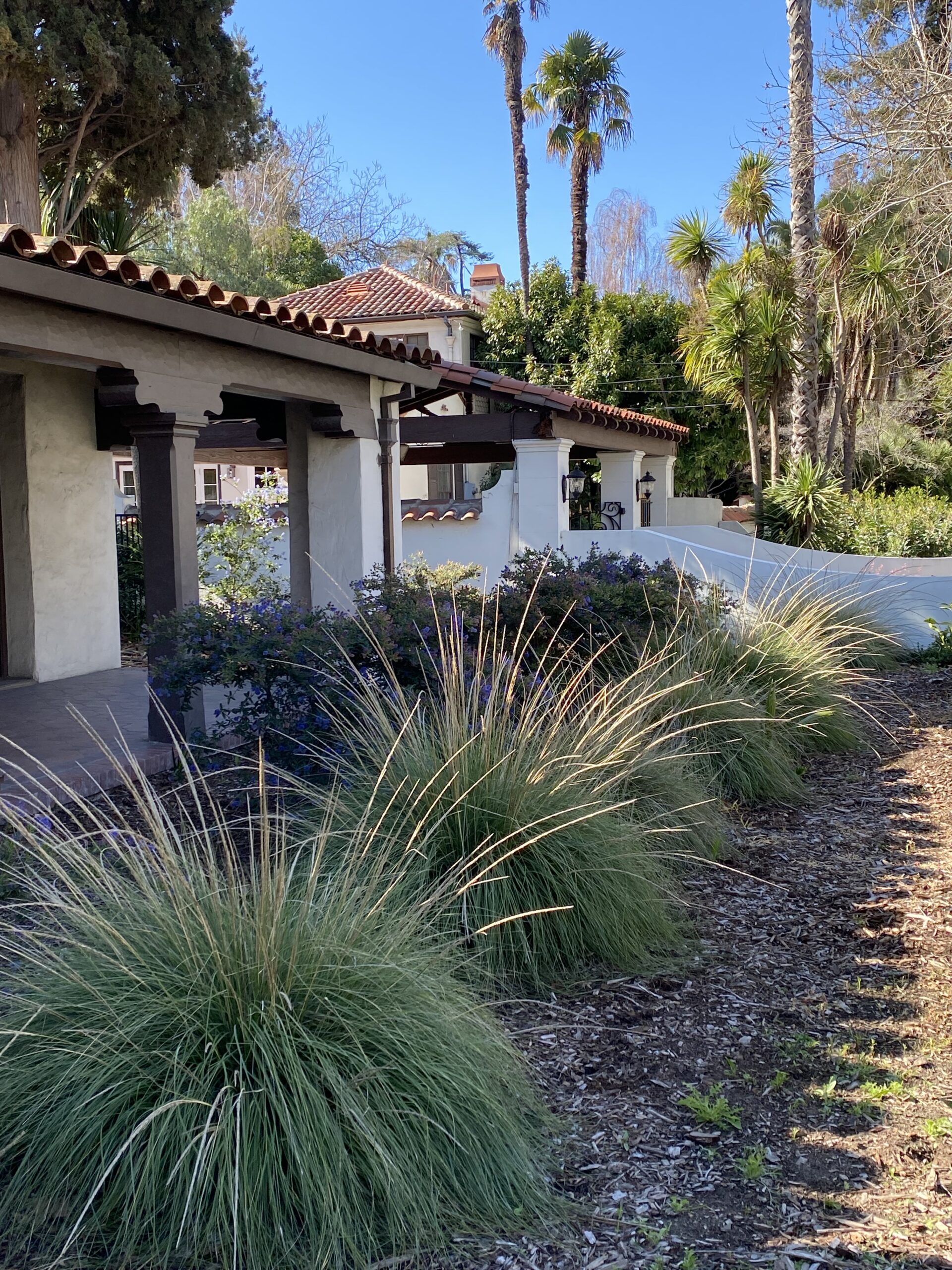
The phrase “the golden rollin’ hills of California,” arises from the seasonal coloration of its many grasses. Dry summers turn all grasses a golden color which contrasts beautifully with the green of forests and shrublands. Perennial bunchgrass prairie used to cover vast areas— thirteen million acres of California’s ecosystems were once pure grassland. Unfortunately, most of the grasses we see in California today are non-native introduced weeds that have displaced the natives through agricultural practices, overgrazing by livestock, and competition by exotic annual grasses, which originated in Europe and Asia.
Historically, the Central Valley grassland was dominated by Nassella pulchra and Nassella cernua interspersed with carpets of annual wildflowers. Vernal pools would have occurred in areas underlain with hardpan soils. As the water dried up in spring, concentric circles of radiantly colorful flowers appeared. Many rare plants existed in such pools alongside their equally rare insect pollinators. These grasslands also supported large herds of deer, Pronghorn Antelope, and Tule Elk.
Like California’s native flora, our native grasslands are remarkably diverse— occurring in landscapes from alpine tundra to coastal dunes, from cool wet meadows to hot, dry deserts. There are 303 species of grass native to California with habits ranging from tufted, clumping bunchgrasses to spreading and sod-forming types
Native grasses have large, complex root systems which penetrate far into the soil and help to increase rainfall penetration and ground water recharge. This often allows them to stay green longer in the spring and re-green earlier in the fall than their exotic annual counterparts, thus providing valuable forage for livestock and wildlife when it is most needed. Historically maintained by natural fire and grazing by native ungulates, these grasslands form a mosaic with other vegetation types in California.
Whether bunching or spreading, grasses help to stabilize soil while keeping the spread of weedy species at bay. Nearly all bird nests are at least partially constructed with grass, while many birds eat grass seeds. There are also many beneficial insects uniquely associated with grass species.
Agrostis pallens, Bentgrass
This is a warm-season, creeping grass found in shady woodlands in the mountains, foothills, and open meadows along the coast. It has light green leaves and delicate flower stalks that reach 2 feet high. A vigorous grower, it soon makes a dense stand that does an admirable job holding the soil. Plant it in full sun or partial shade; Bentgrass is tolerant of both dry and moist conditions.
Bouteloua gracilis, Blue Grama Grass
This warm-season bunchgrass is found in arid areas in southern California on east. It has fine-textured, light green leaves. Delicate flowers which look like eyelashes bloom on foot-high stems from spring through summer. Plant it in full sun in well-drained soil. Blue Grama Grass may be used as a drought-tolerant lawn grass and mowed to a height of 1.5 inches.
Wildlife value: There are 20 species of Grama grass in North America, making them important range plants which cover many of our plains and mesas. The seeds are eaten by wild turkeys, finches, sparrows, Scaled Quail, and many songbirds and small mammals. The foliage is browsed by a myriad of mammals. Grasshoppers eat the flower heads and seeds.
Bromus carinatus, California Brome
This is a cool-season, short-lived bunchgrass found throughout wooded areas in California. Variable throughout its range, it is much used in erosion control mixes (especially with Elymus glaucus) as it is very fast-growing and competitive with many weeds. It blooms from March to July and usually grows 40 to 48 inches high. Plant it in sun or partial shade in either dry or moist conditions. (See also Elymus glaucus, below.).
Wildlife value: Many animals browse California Brome, including Roosevelt Elk, geese, and Western Pocket Gophers and other rodents. Numerous species of rodents and birds eat the seeds.
Calamagrostis brachytricha
This ornamental grass grows in tidy clumps up to 2 feet high. It is medium green in spring and summer and turns a nice shade of yellow in fall. It bears pink flower plumes on long stalks. This grass is very hardy and will survive temperatures to 0 degrees Fahrenheit. Plant it in sun or light shade, and give it moderate amounts of water.
Uses: The flower plumes are great for dried floral arrangements.
Calamagrostis foliosa, Leafy Reedgrass
Leafy Reedgrass is an uncommon perennial grass found on bluffs and cliffs in coastal scrub and forests in northern California. It grows in tufted bunches of narrow blue-green leaves 12 to 24 inches tall. Long, narrow flower spikes rise up to 5 inches above the clump and bear feathery flowers from May through August. Tolerant of most soil types. Requires moderate to occasional water.
Calamagrostis nutkaensis, Pacific Reedgrass
This is a robust wide-leafed clumping bunchgrass which grows up to 3 feet high. Its attractive flower stalks rise to nearly 5 feet tall and start out purple then turn golden with age. It is native along the coast and grows up to 5,700 feet elevation from central California to Alaska. It grows in Pine, Redwood, and mixed evergreen forests, often in seasonally wet, swampy conditions. It thrives on shady, north-facing slopes and can tolerate heavy clay and serpentine soils, wind, salt spray, moderate drought, and some sun. It also does well in tough situations with poor or waterlogged soils and shade.
Danthonia californica, California Oat Grass
One of the most common grasses of the coastal prairie which lies within the summer fog belt, California Oat Grass is also found along the Sierra Nevada foothills. This long-lived bunchgrass can survive up to 200 years. It grows 12 inches high and has light green, twisted leaves. Its flowers, which look like tiny lobster claws, bloom from April to June. It tolerates sun or partial shade and heavy or light soils; it will stay green year-round if given occasional water.
Wildlife value: Attracts a variety of butterflies.
Deschampsia cespitosa ssp. cespitosa, Tufted Hairgrass
This wide-ranging, cool-season bunchgrass is found along streambanks and in meadows, coastal marsh, and forests. This selection was collected in Bonny Doon; it has a variable form with fine medium-green leaves and a very ornamental tawny-gold flowering spike 2 to 4 feet high that shimmers in the spring sunlight. Tufted Hairgrass develops a thatch skirt with age that helps prevent weeds. It is rather tolerant of dry, shady situations, which makes it a fine groundcover under Oaks. This grass is also great for erosion control. Plant it in full sun to light shade; it will go dormant without summer water. This grass tolerates mowing.
Wildlife value: Wildlife use of this grass is variable, but bears do graze upon it. Caterpillars of the Umber Skipper are known to eat this grass, and probably other skippers and grass-eating butterflies do as well.
Deschampsia cespitosa ssp. holciformis, Coastal Hairgrass
This dense, cool-season bunchgrass makes a low mound 6 inches tall. It has fine green leaves and bushy flower spikes to 1 foot high. Plant it in full sun along the coast, and give it moderate water. This is a good grass for coastal gardens that receive salt spray. This grass may be mowed.
Deschampsia caespitosa ssp. holciformis ‘Jughandle’
This selection from Mendocino County grows wider than it does tall and forms tidy clumps that look like dark green pincushions. A typical clump is 8 to 12 inches high and 2 feet wide. This is an excellent grass to plant on sea bluffs or in coastal prairie gardens It may be planted in a coastal garden and serve as a tough lawn either with or without mowing. Plant it in full sun or partial shade; minimal water keeps it green year -round.
Deschampsia elongata, Slender Hairgrass
Slender Hairgrass resembles Tufted Hairgrass bit its leaves are finer-textured and more hair-like. It grows as small upright clumps of basal leaves up to 10 inches high. It has many pale-green or purple-tinged flower stems with delicate, airy, compact flowers. Bright green in spring, it dries to a pale golden color in summer. Plant it in a seasonally moist, partially shaded spot.
Elymus californicus, California Bottlebrush Grass
This uncommon and special grass is found in coniferous forest and has its southernmost limit in the Santa Cruz Mountains. A large grass with soft, wide leaves, it can reach 3 to 6 feet high. It flowers from May to July. Plant it in a semi-shaded situation, and give it occasional moisture.
Wildlife value: Attracts a variety of butterflies.
Elymus glaucus, Blue Wild Rye
This short-lived, cool-season bunchgrass has arching gray-green leaves and a narrow flowering spike which grows up to 30 inches high. It can be found in wooded and forested areas. Although very drought-tolerant, it will accept moisture. Blue Wild Rye is excellent for erosion control and under Oaks. Plant it in either sun or shade. This grass may be mowed as long as it is not cut too short.
Wildlife value: Elk browse Blue Wild Rye, and birds and small mammals occasionally eat the seeds. It provides cover for many types of wildlife. Elymus grasses attract butterflies.
Elymus multisetus, Big Squirreltail
This grass grows in clumps 1 to 3 feet tall. Its stems look like bushy squirrels’ tails. It grows in open, sandy, or rocky areas throughout California. Big Squirreltail blooms from May to July. It has low water requirements.
Wildlife value: Elymus grasses attract butterflies.
Festuca californica, California Fescue
This robust and versatile cool-season evergreen bunchgrass is found on north-facing slopes in the North Coast Ranges south to Santa Barbara County and occasionally in the Sierra Nevada. It is long-lived and grows 2 to 3 feet tall and wide with flower stems that sometimes reach 5 feet high. The flower stalks bloom from March through May and fade to golden tan in summer. Plant in full sun to light shade. It is drought-tolerant and does well on slopes and in poor soils.
Wildlife value: This grass is large enough to provide significant cover; the seeds and foliage of Fescues are used by a variety of birds and mammals.
Festuca idahoensis, Blue Bunchgrass or Idaho Fescue
Festuca idahoensis is a California native despite the species name. This cool-season bunchgrass is native to rocky slopes and openings in woods in many plant communities in the mountains of the Coast Range from Monterey County north to the Oregon border and in the central Sierra Nevada as far south as Tahoe. It is smaller and more delicate than Festuca californica. Densely-tufted, fine-leaved, and long-lived, it forms a bunch or clump usually 1 foot high and wide. It sends up flowering spikes up to 2 to 3 feet tall in spring and summer. This grass takes most exposures and soil conditions if given some moisture, although it can be summer-dormant.
Wildlife value: In California its seeds provide food for the Horned Lark, Goldencrowned Sparrow, White-crowned Sparrow, and Brown Towhee. The seeds and foliage feed the Cottontail Rabbit, Northern Pocket Gopher, California Ground Squirrel, and Western Harvest Mouse. Butterflies are attracted to this Fescue species.
Festuca occidentalis, Western Fescue
Found in Pine-Oak woodlands and Redwood forests, this shade-loving grass lends an airy grace to any woodland garden. Thin, dark green leaves make a soft mound 1 foot tall and wide. Gold flowering stalks rise to 3 feet high from March through July. Plant it in the shade. It is drought-tolerant but looks best if given occasional water. Western Fescue is short-lived.
Festuca rubra, Creeping Red Fescue
This deep green, creeping grass has a soft mounding effect. It takes foot traffic and can be used as a lawn without mowing. It blooms in May and June. Plant it in full sun to filtered shade and give it moderate amounts of water.
Wildlife value: This grass offers cover for smaller birds and animals. Roosevelt Elk eat it. It is also a larval host for the Dodge’s Skipper butterfly along the coast.
Festuca rubra ‘Jughandle’
This is a selection from Mendocino County which forms a small, stiff clump of steel-gray foliage. It looks especially nice in a rock garden setting. Plant it in full sun to light shade; give it moderate water.
Festuca rubra ‘Molate’
Commonly used as turf, Red Fescue is native to California along the coast as far south as Big Sur. It is found in fertile valleys and moist meadows in the coastal ranges and higher mountains of the state. This drought-tolerant selection of Red Fescue is a dark green creeping grass with fine-textured leaves and a soft, mounding habit. It takes foot traffic and can be used as a lawn without mowing. Plant in full sun to filtered shade. Give it moderate water to keep it green, or let it dry out and water it occasionally to rejuvenate. Mix it with Achillea, Sidalcea, Ranunculus, and Iris for a nice meadow look
Hierochloe occidentalis, Vanilla Grass
Found in moist or dry forested areas, this beautiful grass is known for its amazingly sweet, vanilla-like scent. It is fountain-like in form and reaches a height of 3 feet when it flowers in early spring.
Native American uses: Native Americans braided this grass and burned the dried braids in purification rites. The long leaves of sterile shoots were also woven into baskets.
Hordeum brachyantherum, Meadow Barley
This is a cool-season, short-lived perennial grass often found in erosion control mixes with Bromus carinatus and Elymus glaucus. It grows in meadows and on streambanks and grassy slopes. Its short, erect leaf blades form clumps 8 to 24 inches high, though it reaches a height of 30 inches when in flower. The hollow stems may be either erect or sharply bent. Plant it in full sun to partial shade; it will tolerate wet conditions and mowing.
Koeleria macrantha, Junegrass
Junegrass is native to western California and the Cascade and Sierra Nevada Mountain Ranges. It grows in shrubland, woodland, coniferous forests, and alpine settings in dry, open sites that have clay to rocky or sandy soil. The leaf blades are less than a foot high while the flower spikes may be up to 2 feet tall. It prefers full sun but will take some shade.
Wildlife value: Bighorn Sheep, Mountain Goats, elk, White-tailed Deer, and Mule Deer all eat Junegrass.
Leymus condensatus, Giant Wild Rye
This dramatic semi-evergreen grass grows from rhizomes. It is found on dry slopes and in woodlands from Big Sur on south. It can reach up to 8 feet tall, having dense clumps of stout leaves and tall, narrow spikes of flowers held well above the foliage. Plant it in full sun. It is drought-tolerant, though summer water will keep it green. Giant Wild Rye is good for erosion control along the coast.
Leymus condensatus ‘Canyon Prince’
Typically, Giant Wild Rye grows 6 to 8 feet tall or more, but this selection stays a much more manageable size at 3 to 4 feet tall. It has stout blue-green foliage and flower stalks which present themselves above the foliage and dry to a lovely tan color in late summer. Plant it in sun to light shade, and give it moderate to occasional water once established. This is a good, cold-hardy plant for erosion control.
Leymus mollis, American dune wild-rye
Formerly found on beaches from the central coast on north, this creeping grass with its beautiful gray-green leaves has mainly been supplanted by the aggressive, non-native Dune Grass (Aren aria). Plant it in a coastal garden with Beach Strawberry, Buckwheat, Seaside Daisy, and Sea Thrift.
Leymus triticoides, Creeping Wild Rye
This cool-season, rhizomatous grass forms extensive colonies, thus making it a good choice for large-scale meadows. It is found on clay soils and bottomlands from coastal marshes to high Sierra valleys. It has blue-green foliage and grows 2 to 3 feet high. Creeping Wild Rye can go without summer water once it is established, but occasional water will keep it green. This grass is highly adaptable and good for erosion control. Plant it in full sun or partial shade. It is salt-tolerant. This grass may be mowed as long as it is not cut too short.
Melica californica, Western Melica
This attractive green grass grows 1 foot high and has golden flower stalks 2 to 3 feet tall which wave gracefully in the breeze. It is fairly common in rocky areas in grasslands from San Francisco to Santa Cruz and was once a major constituent of Sacramento Valley grassland. Because it is summer-dormant, stop watering it after it blooms. Western Melica creates a beautiful meadow when combined with California Poppies and Blue Flax. Plant it in full sun or partial shade. California Melic spreads from the base and takes two years to fully mature. It may be mowed after it finishes flowering.
Wildlife value: A number of songbirds, including the Lazuli Bunting and Oregon Junco, eat Melica seeds (they also eat Miners’ Lettuce, grasshoppers, and caterpillars).
Melica geyeri, Geyer’s Oniongrass
This perennial grass grows primarily in dry, open woods and grasslands in the mountains of northern California and in chaparral on Santa Cruz Island. It grows as a slender, erect clump with a bulbous base and is usually 3 to 5 feet tall. The leaves are typically 8 inches long, and its spiky, narrow panicles are 4 to 10 inches tall. Although it most often reproduces by seed, the plants can form rhizomes and spread. It is a highly adaptable pioneer species and frequently grows in disturbed areas.
Melica imperfecta, Coast Range Melic Grass
Coast Range Melic Grass is found on dry rocky hillsides in chaparral and woodland from San Diego to Lake County and in the southern Sierra Nevada. This cool-season grass grows 30 inches high and wide. Its light green, fuzzy leaves have a graceful weeping habit. Arching seedstalks appear in spring. Plant this drought-tolerant grass in full sun or partial shade.
Melica subulata
This perennial grass grows as a bulbous-based clump up to 4 feet high. It blooms from March to July and has loose, open flowerheads. The leaves are long, flat, and thin and have hairy upper surfaces. This grass grows in woodland margins and shady sites; it will tolerate either dry or moist situations.
Melica torreyana, Torrey’s Melic Grass
Very similar to Coast Range Melic Grass in appearance. It grows in shady woodlands and clearings from the San Francisco Bay area north to Oregon and in the foothills of the central Sierra Nevada.
Muhlenbergia rigens , Deer Grass
This large warm-season perennial grass is native to chaparral and Yellow Pine forest communities in the Sierra foothills and coastal ranges from Monterey to San Diego Counties. A stunning fountain-like grass, it grows up to 3 feet tall and wide, and its seed panicles rise 4 feet or more high. It blooms in late summer. It takes drought conditions well and will stay green without summer water in many areas. Deer Grass is excellent in mass plantings. Despite the name we haven’t found deer to be particularly fond of it.
Wildlife value: This grass provides significant cover due to its large size.
Nassella cernua, Nodding Needlegrass
This long-lived, spreading cool-season bunchgrass reaches 18 inches tall and sends up flowering stalks to 3 feet high. It has graceful seedstalks and is very similar to Purple Needlegrass in appearance. Plant this drought-tolerant grass in full sun; it is adapted to sandy, well-drained, loamy soils.
Wildlife value: Needlegrasses attract butterflies.
Nassella lepida, Foothill Needlegrass
This fine-bladed, tufted bunchgrass is commonly found along chaparral margins in the Coast Ranges and in the Sierra foothills. Its graceful 2 feet tall flowerstalks have needlelike awns that shimmer in the afternoon light. Foothill Needlegrass is not as long-lived as other Needlegrasses, but it can handle light or heavy soils and is very drought-tolerant. Plant it in full sun. Minimal water will keep it green all year; otherwise the leaves will turn a reddish-gold until the next rainy season.
Wildlife value: Attracts a variety of butterflies.
Nassella pulchra, Purple Needle Grass
Our state grass was once known by the botanical name Stipa pulchra but is now recognized as a Nassella. It is a long-lived, cool-season bunchgrass that may be found in Oak woodlands, chaparral, and grasslands. Clumps of stiff, light green leaves grow 2 feet tall and send flower stalks up to 3 feet high. The seedheads have purple needle-like awns that shimmer in the sunlight and turn a golden yellow along with the leaves when the plant goes dormant in summer. Purple Needle Grass is good planted in groups 1 to 2 feet apart and interspersed with wildflowers. It does well under Oaks or in poor or heavy clay soil. Plant this extremely drought- and heat-tolerant grass in full sun. It is slow-growing at first and can be out-competed by weeds; do not fertilize the planting area as this will stimulate weed growth.
Wildlife value: Huge herds of Pronghorn Antelope, Mule Deer, and Tule Elk once feasted upon this grass in the historic California prairie. It also provided food and habitat for Jackrabbits, Beechey Ground Squirrels, Kangaroo Rats, and Pocket Gophers .
Poa secunda, Pine Bluegrass
This is an attractive low-to-medium-growing cool-season perennial grass. It forms narrow tufts of soft lower foliage with tall flowerstalks. It matures early and blooms in May, then goes dormant until the next rainy season. Pine Bluegrass grows well on protected or open hillside sires. Plant it in good soil, and do not give it any water after it finishes blooming.
Wildlife value: Townsend’s Ground Squirrels eat this grass. It is also a prime forage grass for hoofed browsers including livestock.