
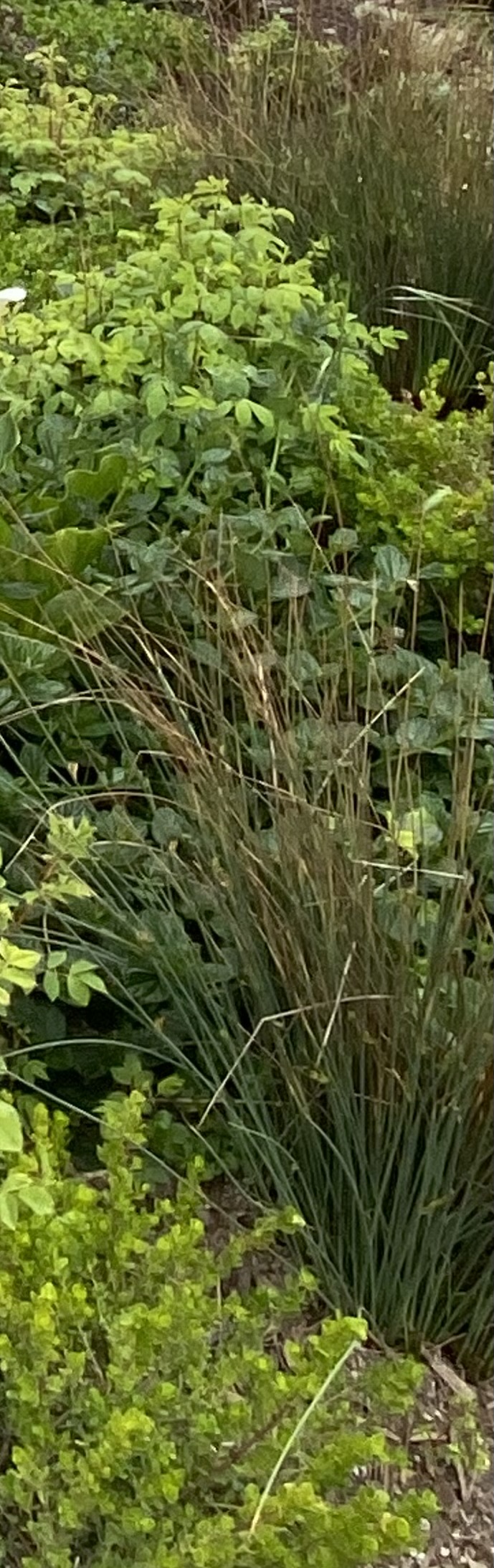
Carex Species
Wildlife value: Sedge seeds are of major importance to waterfowl and seed-eating songbirds. Sedges in wetlands provide valuable nesting cover for ducks. Carex species also attract butterflies.
Carex barbarae, Santa Barbara Sedge
This perennial clumping Sedge grows 10 to 40 inches tall. It is commonly found on open or brushy slopes in seasonally moist valley flats and will grow at elevations ranging from sea level to 3,000 feet. Santa Barbara Sedge is a member of many plant communities, including coastal prairies, valley grasslands, foothill woodlands, and mixed evergreen and Yellow Pine forests.
Carex harfordii, Harford’s Sedge
Found in marshy soil, this evergreen Sedge has a bunching habit and delicate, fine textured light green leaves similar to Carex tumulicola (below). It grows 18 inches tall and wide. Plant it in full sun to partial shade, and give it regular water.
Carex pansa, Dune Sedge
Found growing in sand dunes from the central coast on north, this creeping Sedge has dark green, shiny leaves. It reaches 1 foot tall and spreads widely by rhizomes. It makes an excellent dense evergreen turf which can be kept mowed or natural. Plant it in sun or shade in any type of soil.
Carex praegracilis, Meadow Sedge
Commonly found in moist, sandy, often alkaline places throughout North and South America. It is a low-growing (to 1 foot tall) spreading groundcover very similar to Carex pansa (above). Plant it in full sun along the coast or in partial shade inland, and give it moderate amounts of water. An aggressive spreader, this is a good plant for stabilizing eroding soils.
Carex tumulicola, Berkeley Sedge or Foothill Sedge
Found in meadows and open woodlands, this common evergreen Sedge forms a dark green, tight clump of shoots with narrow, arching leaves which give it a fountain-like effect. It is quickly and easily established, and stays looking good year- round. It tolerates a wide variety of growing conditions. Plant it in either sun or shade, and give it some water. This Sedge is an excellent erosion control plant.
Equisetum hyemale ssp. affine, Scouring Rush
Scouring Rush is a plant with a very long history. It once covered much of the world’s surface and fed herbivorous dinosaurs, in fact. It has hollow green stems which grow to 4 feet high; each stem is segmented and has black-and-tan rings at its joints. It is evergreen, essentially leafless, and flowerless. It produces small cone-like spikes full of spores. Plant it in sun or light shade; although it prefers wet soil, it will grow in drier places. This plant is extremely invasive, so plant it in a heavy-duty container or other area where it can be controlled.
Wildlife value: Snow Geese and Whistling Swans eat the rootstocks and stems. It is very likely that other waterfowl do so as well.
Uses: Because this plant contains silica within its stems’, it was once used to clean dishes and polish wooden objects.
Equisetum hyemale var. robustum, Horsetail
Like bamboo this spreading plant is very hard to contain in a garden setting. Best planted in concrete barrier areas such as sidewalk strips, or in containers. Commonly found throughout North America along streams and in moist sandy or gravelly areas. It has attractive stiff, upright jointed stems. Horsetail grows up to 6 feet tall. Plant it in moist areas in partial shade inland and in full sun along the coast.
Wildlife value: Snow Geese and Whistling Swans eat the rootstocks and stems. It is very likely that other waterfowl do so as well.
Uses: Because this plant contains silica within its stems, Horsetail was once used to polish wood and tin.
Juncus effusus
A nearly cosmopolitan plant, meaning it is found all over the world, in moist places including salt marshes in coastal areas from southern California north to British Colombia. It forms a dense rounded clump up to 2 feet high and wide. This Rush is good for erosion control along streambanks. Plant it in full sun or partial shade, and give it regular water for best results.
Wildlife value: Possibly because of the tight bunching stems and proximity to water, we often see clumps of ladybugs gather in large groups to diapause (hibernate) on
Juncus patens, Rush
This Rush grows throughout most of California. It makes a small, upright clump of blue-green or gray-green stems about 2 feet high. Stiff brownish-tan, red-tinted flowers bloom throughout the summer. Plant it in sun or shade; although it likes moisture, it will grow in almost any situation. Rushes are good for erosion control, under Oaks, and in containers.
Juncus xiphioides, Rush
This creeping perennial Rush is native to Oregon, California, Arizona, and Baja California. It grows 18 to 30 inches tall and has tufts of small brown flowers clustered toward the tips of its stems. Plant it in moist soil in sun to partial shade. This plant spreads by rhizomes, which makes it useful for soil stabilization but also means that it may become invasive.
Scirpus californicus, California Bulrush
This is large Rush is native to our freshwater marshes, rivers, and creeks. It also grows in brackish water. It grows 3 to 6 feet tall and can form dense colonies over 10 feet wide. The stems are triangular. It tolerates full sun or partial shade, no drainage, and seasonal flooding. Wildlife value: The seeds, roots, and stems are important food sources for the mammals, birds, and aquatic creatures which live in the riparian areas where California Bulrush is found.
Scirpus cernuus, Fiber-optic Plant
This small, tufted Tule is often found in seeps on coastal bluffs and generally in moist places elsewhere. It grows 6 to 10 inches tall and spreads to 12 inches wide. It has very thin, thread-like leaves which remain green throughout the year and a drooping habit. Little brown ball-like flowers are borne at the ends of the blades. Plant it in the sun or in partial shade in a wet place. This plant likes water and will do well at the edge of a pond or tucked among rocks with other moisture-loving plants. Fiber-optic Plant also does well in containers. It is a San Francisco Bay area native.
Typha angustifolia, Narrow-leaved Cattail
This erect, stout perennial is common in freshwater marshes below 2,000 feet. It has long, flat, light green leaves which range from one-eighth inch to five-sixteenths inch wide. The flowers are borne on tall spikes; female flowers appear in cigar-shaped clusters. Narrow-leaved Cat-tail blooms in June and July. Its roots are quite invasive; if a spreading colony is not desired, plant it in a very sturdy, impenetrable container. This plant grows in marshy soil or standing water.
Wildlife value: Waterfowl and Muskrats eat this plant, and Muskrats make their lodges with it. Blackbirds perch on the plants. Waterfowl, Muskrats, and White-tailed
Deer use Narrow-leaved Cattail for cover.
Other uses: The rhizomes may be eaten whole or ground into flour, and the shoots, leaves, flowers, pollen, and stems are also edible. The stems and leaves can be woven into baskets or rope. They may also be used as bedding and roofing materials. Paper manufacturing plants sometimes use the stems to produce pulp.
Typha latifolia, Broad-leaved Cattail
This erect, stout perennial is common in freshwater marshes below 2,000 feet. It has long, flat, light green leaves which range from three-eighths inch to one-and-one-eighth inches wide. The flowers are borne on tall spikes; female flowers appear in cigar-shaped clusters. Broad-leaved Cattail blooms in June and July. Its roots are quite invasive; if a spreading colony is not desired, plant it in a very sturdy, impenetrable container. This plant grows in marshy soil or standing water.
Wildlife value: Muskrats and geese eat the rhizomes and basal portions of Broad-leaved Cattail, but ducks do not like it. The very small seeds are eaten by a very few birds, including Green-winged Teals, Semipalmated Sandpipers, Canada Geese, Snow Geese, and Tule Geese. Red-winged Blackbirds, Yellow-headed Blackbirds, and Marsh Wrens nest in stands of this Cattail; ducks will only nest in this plant if Broad-leaved Cattail stands and open water cover roughly equal areas. Muskrats build huts from this plant, and deer occasionally take cover in stands of it.
Native American uses: The rhizomes were dried and ground into flour or cooked and eaten as vegetables. Young shoots were eaten raw or cooked, and immature fruiting spikes were roasted and eaten. Mats were woven from the leaves, and the down from ripe fruits was used as padding and in diapers.
Other uses: The leaves and stems have been used worldwide to make boats and rafts, baskets, shoes, paper, and ropes. They may also be used as matting, bedding, and roof thatching materials. Broad-leaved Cattail has been proposed in recent years as a biomass crop for renewable energy.