
Abies bracteata, Santa Lucia Fir
Originating from the Santa Lucia Mountains in Monterrey County, this tree can grow to be 100 to 150 feet tall at maturity. Its dense, declining branches start at nearly ground level and produce a broad, pyramidal shape which abruptly narrows 15 to 20 feet from the top to form a thin, spire-like head. The needles are flat, stiff, and light green; yellow flowers bloom in May and are followed in fall by 3-to-4-inches long cones with long, needle-like bristles on the ends. It occurs naturally in moist canyon bottoms and on dry rocky summits over 3,000 feet.
Acer circinatum, Vine Maple
This long-lived small tree or shrub is native to moist woods and streambanks from British Columbia to northern California. Although it can reach heights of 20 to 30 feet, it is usually smaller. Vine Maple shows a variety of growth forms depending upon the light level of its situation: In the open, it is usually denser with several erect stems, while in shady areas it often has fewer stems and a prostrate habit with branches rooting where they tough the ground. The leaves turn beautiful shades of yellow, orange, and red in the autumn, and the smooth, bright reddish-brown bark is attractive year-round. Vine Maple produces rose-colored fruits. Vine Maple prefers moist, well-drained soils. This tree is somewhat difficult to find in nurseries.
Wildlife value: Black-tailed Deer and elk browse the abundant foliage; elk will also browse the twigs in winter. Numerous birds and small mammals eat the seeds, buds, and flowers of Vine Maple. Squirrels and chipmunks store the seeds in caches. Many types of birds use the leaves and seed stalks in nest building. Dense shrubs provide good cover for deer, elk, smaller mammals, and birds.
Native American uses: Native Americans called Vine Maple “Basket Tree” because they used its long, straight stems to weave baskets. They also carved its wood into spoons, platters, bowls, and other household items and used its branches as scoop nets for catching salmon.
Acer macrophyllum, Bigleaf Maple
This tree grows in many plant communities, often on stream banks and in canyons. Its large, dark green leaves through spring and summer create an excellent fast-growing shade tree. It has beautiful yellow fall color before becoming deciduous in winter. It is faster-growing with water. Plant it in sun or part shade.
Wildlife value: Many kinds of birds eat Maple seeds, buds, and flowers. Squirrels eat the seeds and store them in caches. Birds build nests with the leaves and seed stalks. Deer browse the foliage.
Acer negundo, California Box Elder
This is a fairly small tree of the Maple group which grows to 30 feet and has bright green foliage in early spring and winged seeds which are red when young. The Box Elder is common throughout the Coast Ranges where it grows along the banks of creeks and streams, often in the understory of Bays, Redwoods, and other native trees. It is very fast growing.
Wildlife value: Maple seeds as well as buds and flowers provide food for many kinds of birds and other animals. Squirrels and chipmunks eat the seeds and often store them in caches. Birds use the leaves and seed stalks to build nests, and deer will browse the foliage.
Aesculus californica, California Buckeye
This medium sized native tree is endemic to California and is found all over the state. California Buckeye is often multi-trunked and grows 20 to 40 feet tall. It is a stunning specimen in flower but most striking in winter when its picturesque gray, twisting limbs are bare of leaves. It is quite tolerant of sun or shade, drought, or water.
Wildlife value: The California Buckeye is a most important nectar source for butterflies. Its flower buds feed caterpillars of the Azure Blue while the nectar of the open flower draws many butterflies, including the California Sister, Great Purple Hairstreak, Western Tiger Swallowtail, and Mourning Cloak. Many other insects visit its flowers, and this brings the Black-headed Grosbeak and other songbirds along to forage for insects.
Native American uses: Surprisingly, California tribes ate California Buckeye seeds as a staple food by roasting the seeds, mashing them, and finally soaking them in water to leach the poison. They also stunned fish for easy capture by placing seeds in nets or baskets in streams and other waterways.
Alnus rhombifolia,White Alder
This is a very fast-growing tree which grows from 50 to 90 feet high and spreads up to 40 feet wide at the crown. It is native to nearly all the foothills of California except those on the coast. Because it likes plenty of water, consider planting it beside a creek. It has coarsely-toothed, dark green leaves from 2.5 to 4.5 inches long and wide, and its branches are often pendulous at the tips.
Wildlife value: Redpolls, siskins, and goldfinches eat the seeds. As part of a riparian woodland community, White Alder contributes to structural diversity (an important factor in bird habitat). This tree attracts butterflies.
Native American uses: Native Americans used this plant to make red dye.
Alnus rubra, Red Alder
This deciduous tree grows in wet coastal areas from Santa Cruz to Washington. It is distinguished from White Alder by its leaf margins that roll tightly under and by the presence of rusty hairs on the undersides of the leaves. It is found along creeks on the north coast of Santa Cruz, where it quickly grows up to 75 feet tall. Red Alder is useful for erosion control on steep slopes where soil has been disturbed because the heavy cover and litter layer which forms within 3 to 5 years effectively protects the soil. Plant it in sun or shade and give it lots of water. The roots are both invasive and nitrogen-fixing.
Wildlife value: Redpolls, siskins, and goldfinches eat the seeds, which are also a very important food source for Deer Mice. Beavers eat the bark and make dams and lodges form the stems. Young plants are attractive to browsers. Red Alder also contributes to structural diversity in the riparian woodland community. Butterflies visit this tree.
Native American uses: Native Americans used the inner bark of this plant to make a red dye which they used to make their fish nets less noticeable in the water. Because Red Alder contains salicin, which acts chemically similarly to aspirin, it was used in many medicinal preparations.
Arbutus menziesii, Madrone
Often called “the world’s most beautiful tree”, this fine broadleaf evergreen offers bright orange berries in fall, clusters of creamy white flowers in spring, and beautiful smooth, exfoliating reddish-brown bark year-round. It grows somewhat slowly (making it good to interplant with fast-growing Bigleaf Maple) to 40 feet as the trunk twists into attractive shapes. Plant it in light shade to full sun in good loamy soil and give it some water. This plant will suffer if its roots are handled. Do not pry or prune the roots.
Wildlife value: Orange berries feed the Band-tailed Pigeon, Long-tailed Chat, American
Robin, Montezuma Quail, a variety of thrush, and numerous mammals, including Mule Deer, raccoons, and ringtails. Both open-nesting and cavity-nesting birds favor the Madrone for nesting sites. Bees love Madrone. Butterflies visit this tree.
Native American uses: West Coast tribes ate the berries and made eating utensils from the roots.
Betula occidentalis, Water Birch
Glenn Keator describes Water Birch as “one of the undiscovered gems of the shrub world.” This deciduous shrub or small tree can be found on rocky streambeds in the eastern Sierra Nevada Mountains. Attractive throughout the seasons, this moderate-tofast-grower may reach up to 25 feet tall. Water Birch does well in containers and next to ponds and can be planted in groups. Plant it in full sun or part shade and give it constant moisture.
Wildlife value: Numerous bird species, including several species of grouse, redpolls, Pine Siskins, chickadees, and kinglets, eat Birch catkins, buds, and seeds. The Broadtailed Hummingbird and Red-naped Sapsucker feed on sap oozing from holes made in the bark by sapsuckers. Beavers build dams and lodges with Water Birch stems. Hoofed browsers will eat the foliage and twigs when tastier fare is scarce. Cavity-nesting birds utilize mature trees. Plants overhanging streambanks provide shade and organic matter important for fish habitat.
Calocedrus decurens, Incense Cedar
Millions of visitors to Yosemite Valley have seen this large evergreen tree. It is native from the mountains of southern Oregon to the northern parts of Baja California and ranges east to western Nevada. Although it grows slowly at first, it may grow up to 2 feet per year once it is established and will eventually reach 75 to 90 feet tall with a wide, pyramidal shape. Its common name comes from the delightful fragrance it gives off in warm weather. It has flat sprays of green foliage, reddish-brown bark, and small yellowish-brown to reddish-brown cones which look like duck bills when they open. This tree is very adaptable but prefers full sun and a little water.
Wildlife value: Incense Cedar is primarily valuable for the cover it provides to wildlife. Small mammals will eat the seeds, but they are not a favorite food source (oils in the seeds may make them unpleasant). Mule Deer occasionally browse the foliage. Incense Cedar also attracts butterflies.
Other uses: The wood is resistant to decay and therefore valued for construction purposes. Most top-quality Incense Cedar wood, however, is used to make pencils.
Chitalpa tashkentensis ‘Pink Dawn’
This fast-growing tree or shrub grows 20 to 30 feet tall and wide. It is the result of a cross between two different genera of California native plants, Catalpa bignonioides (Indian Bean) and Chilopsis linearis (Desert Willow). This bi-generic hybrid combines the beautiful flowers of the Catapla with the desert hardiness of the Chilopsis. It is a deciduous tree; its leaves are 4 to 5 inches long and 1 inch wide. The selection ‘Pink Dawn’ was chosen for its frilly pink trumpet-shaped flowers which bloom spring through fall. Chitalpa is sterile (it does not produce seed pods). It is a good choice for a patio tree because its long tap root will not ruin paving. Plant in full sun. This plant is heat-tolerant, cold-tolerant, and drought-tolerant and can withstand strong winds without breaking. It will, however, mildew in cool coastal areas.
Wildlife value: Hummingbirds and butterflies, bees, and other beneficial insects enjoy the nectar of Chitalpa blossoms.
Chrysolepis chrysophylla var. chrysophylla, Giant Chinquapin
This large, slow-growing tree or shrub grows in coniferous forest, closed-cone pine forest, and chaparral plant communities. Its glossy evergreen leaves have gold undersides. It can be clipped to form a hedge. This tree is difficult to transplant and may need mycorrhizal associates. It appreciates occasional summer fog. Locally, it can be seen along Empire Grade in Bonny Doon.
Wildlife value: Nuts are enclosed in a spiny bur and eaten by many birds and mammals, especially squirrels who gather them early in fall as the burs begin to open.
Native American uses: Native Americans roasted Giant Chinquapin nuts in coals. They were eaten whole or pounded into meal, and they could be stored for winter use. The leaves were used to make tea.
Cupressus abramsiana, Santa Cruz Cypress
Known only from four groves in the Santa Cruz Mountains, this endangered evergreen grows on sandstone outcroppings or inland marine sandhills. Quickly reaching 15 to 30 feet, it has a more delicate appearance than the commonly planted Monterey Cypress. It makes a good windbreak. Plant this drought-tolerant tree in sun or part shade.
Wildlife value: Birds eat the seeds.
Native American uses: Native Americans used the leaves as a treatment for rheumatism and to help women regain strength after childbirth.
Cupressus macrocarpa, Monterey Cypress
This native of the Monterey Peninsula grows to 40 feet tall. Young trees are narrow and pyramidal while older or wind-blown trees spread out more. Healthiest where it receives cool coastal breezes, this tree makes a useful evergreen windbreak.
Wildlife value: Deer and rodents eat Monterey Cypress seedlings. Birds eat the seeds.
Juglans californica var. hindsii, Northern California Black Walnut
This rare deciduous tree was formerly cultivated as rootstock for the English Walnut with which it hybridizes readily. It grows 30 to 60 feet tall with a single trunk and a broad crown. Edible walnuts with thick shells have green husks that mature to dark brown in summer and fall. It is a hardy, drought-tolerant species that thrives in poor soil where many other plants do not fare well.
Wildlife value: Songbirds and squirrels eat the nuts. Deer, nesting birds, and rodents use this tree for cover. Owls and other raptors nest in the upper reaches of the crown, and California Ground Squirrels dig nests at the bases of older trees.
Native American uses: Native Americans used an infusion of the leaves to treat “thin” blood. Chumash ate the nuts and used the shells as dice. The hulls were used to make a dye used in basketry.
Lithocarpus densiflorus, Tanbark Oak
This is a common broadleaf evergreen tree of Redwood and mixed evergreen forests throughout California and Oregon. Its height is variable dependent on habitat. In our area, it is usually between 10 and 40 feet tall. It is exceptionally shade tolerant and forms low bushes or small trees in the shady Redwood forest. In garden conditions the branches often touch the ground, forming a handsome conical, densely-foliaged tree. It is at its best planted in full sun to light shade; give it little water once established.
Wildlife value: Tanbark Oak offers value as cover and nesting sites for a wide variety of birds and animals. Cavity-nesting birds nest in tree hollows, and many other types of birds and small mammals make their homes in its branches. Several types of salamanders rest and hide in the cover of fallen logs. Black Bears, California Ground Squirrels, and Redwood Chickarees eat the acorns, as do the California Woodpecker, Band-tailed Pigeon, and several species of thrush.
Native American uses: Early Californians favored Tanbark Oak acorns over other acorns because of their high oil content. The acorns were soaked in water to leach out the tannins and then either pounded into mush or dried and ground into flour.
Lyonothamnus floribundus ssp. aspleniifolius, Fern-leaved Catalina Ironwood
This very ancient evergreen tree is found only on Santa Catalina, Santa Cruz, Santa Rosa, and San Clemente Islands. Tall and narrow with shredding gray bark, it reaches 15 to 50 feet tall. Large clusters of cream-colored flowers appear in summer. It prefers a location near the coast in sun or light shade and well-drained soul. This tree benefits from deep watering after establishment. It can be pruned into a shrub or hedge or planted in a large container.
Pinus Species
Wildlife value: Pines rank near the top in importance to wildlife, providing shelter, food, and nesting sites. Their oily seeds constitute a large part of the diet of a number of birds– including the Common House Finch, Pine Siskin, chickadee, Mourning Dove, Dark-eyed Junco, California Jay, Pygmy Nuthatch, and Plain Titmouse– and many small mammals. The needles are eaten by grouse and a number of browsers, and the foliage is important wildlife cover. Porcupines and small rodents use the bark and wood as food. Larger pines are used as roosting places for robins during migration and are a common nesting site for Mourning Doves. Many Pine species also attract butterflies.
Native American uses: Native Americans used Pines for almost every purpose imaginable. Listed here are only a few of those uses: The pitch was chewed to relieve
rheumatism and applied to burns as a salve; it was used as a glue to mend canoes and to fasten arrowheads and feathers to shafts. Charcoal made from crushed nuts was applied to burns, sores, and abrasions. Pine nuts were eaten fresh, roasted, boiled, or pounded and mixed with cold water. The inner layer of bark was eaten as an emergency food source.
Other uses: A tasty tea rich in vitamin C can be made from Pine needles.
Pinus attenuata, Knobcone Pine
This coastal mountain species grows in dry, barren, rocky places below 4,000 feet. It is a fairly fast-growing Pine reaching 30 feet in good conditions. Its slightly pyramidal shape in youth opens up with age. This is a fairly undemanding tree which will do best with some summer water and fertilizer.
Pinus contorta ssp. contorta, Shore Pine
This coastal Pine has a short, heavy trunk (often contorted) and a broad, compact or open crown. It grows at a moderate rate to 20 or 30 feet. It is long-lived and can be pruned into very elegant specimens. It is excellent in small gardens.
Pinus coulteri, Bigcone Pine
This evergreen tree grows on dry, rocky slopes from 1,000 to 7,000 feet on Inner Coast Ranges from Contra Costa County south to the mountains of southern California. It is a medium to large tree 35 to 75 feet high with a moderate growth rate which forms a somewhat pyramidal shape. As the name implies, the cones are unusually big and remain on the tree for several years. This useful ornamental is tolerant of heat, drought, and wind.
Pinus monophylla, Single-leaf Pinyon
Single-leaf Pinyon may be found growing alongside Junipers on dry, rocky slopes and ridges from 3,500 to 9,000 feet along the eastern slopes of the Sierra Nevada, in the mountains around the Mojave Desert, and in a few places along the western base of the Sierra Nevada north to Tuolumne County. It is Nevada’s state tree. It grows slowly to a height of 45 feet. Plant it in full sun in well-drained soil.
Wildlife value: Single-leaf Pinyon offers food and shelter for many birds and reptiles, and Pinyon-Juniper forests are home to a wide variety of large mammals including Bobcats, Mountain Lions, wild horses, Black Bears, Desert Bighorn Sheep, and several species of deer. Pinyon Mice, Deer Mice, Woodrats, chipmunks, squirrels, deer, Desert Bighorn Sheep, and Black Bears eat the seeds; so do Clark’s Nutcrackers, Pinyon Jays, Steller’s Jays, and Scrub Jays. Mule Deer sometimes moderately browse the needles. Porcupines love the inner bark, which is also eaten by squirrels, raccoons, rabbits, ringtails, coyotes, and Gray Foxes. Pitch Midges eat the pitch, and Dianthidium genus bees use it to make their nests. Sawflies eat the needles and pollen.
Native American uses: E.K. Balls writes, “This tree provides one of the most important items of food for many of the Indian tribes, and whole villages traveled many miles to harvest the seeds…. They are still much sought-after.” Single-leaf Pinyon has provided food, fuel, medicine, and shelter to Native Americans for millennia.
Pinus muricata, Bishop Pine
Bishop Pine is frequently dominant in closed-cone Pine forests. It may have almost no understory in dry, rocky areas, but it will support a larger plant community in moister areas. Its seeds are held in its closed cones for several years until hot weather or fire releases them. This tree grows rapidly to 40 or 50 feet high. It is excellent on the coast and makes a very good windbreak tree. Because it grows a little more slowly and densely than the related Monterey Pine, it doesn’t get quite as big and is less likely to topple. Bishop Pine grows in clay soils better than most Pines.
Wildlife value: Although squirrels may occasionally eat the seeds of Bishop Pine, its spiny cones usually deter seed-eaters.
Pinus ponderosa , Ponderosa Pine
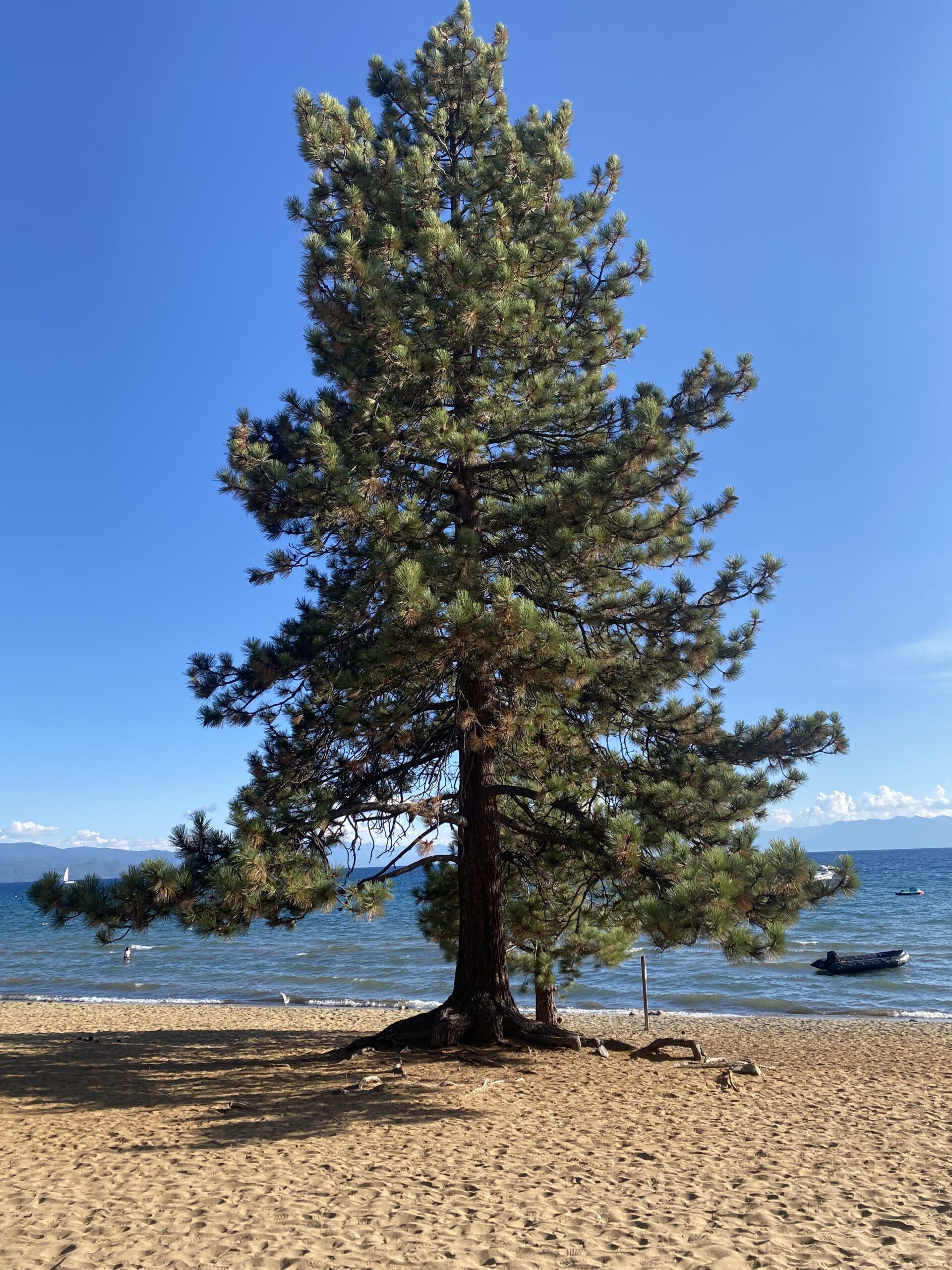
This handsome Pine is found from British Columbia to Mexico. Locally it is found in Scotts Valley growing on sandy slopes, but it is also common around Lake Tahoe. It is notable for its attractive bark, which forms large mahogany plates. It may grow moderately or rapidly to 50 or 60 feet. While young it is a straight-trunked, well-branched tree; with age it becomes stately with an open crown. This is a very hardy and attractive tree at all ages.
Wildlife value: Gamebirds, songbirds, and small mammals eat pine nuts. Pine needles are consumed by some species of grouse. Porcupines and small rodents use the bark and wood as food. Bald Eagles, Wild Turkeys, Band-tailed Pigeons, and migrating robins roost in this tree; squirrels, hawks, and owls nest in it. Ponderosa Pine offers important wildlife cover and shelter at every stage of its development.
Native American uses: Tribes in the Pacific Northwest ate the inner bark and made a salve from the resin which was used to treat rheumatism, backaches, and dandruff.
Pinus sabiniana, Gray Pine
This Pine grows on dry slopes and ridges below 4,500 feet in the Inner Coast Ranges. It usually has a divided trunk supporting an open, airy crown. It grows rapidly to 40 to 60 feet tall both in dry areas and damp coastal areas. Its airy foliage allows for planting underneath. This tree is a good choice for steep hillsides with poor soil. A few companions are Ceanothus, Coyote Bush, Manzanita, and Monkeyflower.
Wildlife value: This pine is especially valued for its abundance of large, oily seeds. Songbirds and small mammals love them. California Quail and Mourning Doves shelter in these trees.
Native American uses: California tribes particularly favored the pine nuts.
Platanus racemosa, California Sycamore
Commonly found along waterways below 4,000 feet in a number of plant communities throughout California, this large, robust tree grows up to 75 feet high and has large, maple-like leaves. It has attractive mottled bark and a nice branching structure. This is an excellent shade tree and one of the few natives which could be planted in a lawn and tolerate full irrigation. It withstands heat and is wind-tolerant; plant it in light shade to full sun.
Wildlife value: As do many tall trees, California Sycamore provides roosting and nesting sites for a number of songbirds. Goldfinches and other birds eat the seeds. This tree also attracts butterflies and hummingbirds.
Populus balsamifera ssp. trichocarpa, Black Cottonwood
Found on alluvial bottomlands and along streams throughout California and elsewhere, this is the largest broad-leafed tree in the Pacific West. This handsome, wide-crowned deciduous tree may attain a height of 90 feet. The bark is deep gray and furrowed, and the smooth, triangular leaves are dark green on top and lighter underneath, without the exaggerated heart shape of the Fremont Cottonwood’s serrated leaves. Black Cottonwood grows in Santa Cruz and Santa Clara Counties along watercourses. Reddish-brown leaf buds are very resinous and fragrant when opening in late winter and early spring. Fall leaves are darker and more golden-green than those of Fremont Cottonwood. Plant it in full sun and give it frequent to moderate water.
Wildlife value: The buds and catkins of Cottonwoods provide winter and spring food for various kinds of grouse. Rabbits and hoofed browsers eat the tender bark, twigs, and foliage freely. Beavers and porcupines relish the bark. Cottonwoods provide invaluable perching, roosting, nesting, and foraging sites. In fact, a vast array of birds— from hummingbirds to Bald Eagles, woodpeckers to owls, and bluebirds to hawks— roost and nest in this tree species. It also attracts butterflies.
Populus fremontii , Fremont Cottonwood
This deciduous tree is common in moist situations throughout California and down into Baja. Usually found below 6,500 feet, one may see it locally along creeks and streams in Santa Clara County. This handsome tree often grows to 90 feet with trunks 5 feet in diameter and wide branches which form a large crown. The most striking and memorable attribute is the way the heart-shaped leaves shimmer and rustle when a warm breeze hits them on a perfect spring day.
Wildlife value: The buds and catkins of Cottonwoods provide winter and spring food for various kinds of grouse. Rabbits and hoofed browsers eat the tender bark, twigs, and foliage freely. Beavers and porcupines relish the bark. Hawks, eagles, and woodpeckers are especially attracted to Fremont Cottonwood stands, although many other birds forage and nest in this tree. Many small animals use this tree for cover as well, and the shade and leaf litter provided by streamside trees contribute greatly to aquatic wildlife habitat. It also attracts butterflies.
Native American uses: Poultices were made form the bark and leaves to treat cuts, sores, and headaches. The wood was used to make drums, tools, dishes, statues, and, in the case of the Quechan, cremation fires for their dead.
Pseudotsuga menziesii var. menziesii, Douglas Fir
Well known as a Christmas tree, this stately conifer is found in western Oregon,Washington, and parts of the Rocky Mountains; it extends to Alaska and is found in California as far south as Fresno and Monterey Counties. It is common in our area as a component of the mixed evergreen forest. Pyramidal in youth, it can eventually reach 70 to 250 feet. Densely packed, two-ranked dark green needles radiate out in all directions from the branches and twigs and have a sweet aroma. Female cones hang down and ripen in the fall. It is tolerant of most soils except mucky ones but does not grow well in windy areas. It is heat- and drought- tolerant but will stay smaller and denser if it receives less water. It is best planted in full sun or part shade.
Wildlife uses: Western Tree Squirrel, Douglas Chickaree, Red Tree Mouse, and Red Tree Vole eat the small winged seeds, pollen cones, and young needles of this tree. Red Tree Voles make their nests almost exclusively 6 to 157 feet off the ground in Douglas Fir trees. Snags in old-growth Douglas Fir forests provide a wide array of sites for the nests of cavity-nesting forest birds. Such old-growth forests are the primary habitat of the federally-protected Spotted Owl. Porcupines eat the bark. Douglas Fir attracts butterflies.
Native American uses: This tree was extensively used by Native Americans for lumber and to make harpoon shafts and other implements. The pliable roots were used to weave baskets.
Quercus Species
When one thinks of California, it is inevitably the Oak that springs to mind. Our state has been blessed by the presence of 29 species of this beautiful genus, ranging in form from scrubby groundcovers to stately trees, evergreen to deciduous. Thousands upon thousands of acres of California’s Oak woodlands have been lost to development and agriculture. The loss of even a single Oak has an incalculable effect on local wildlife, as so many creatures depend upon this genus for their very lives. Unfortunately, many species of Oaks are not regenerating very well on their own. Coast Live Oak, Blue Oak, and Tanbark Oak are currently being threatened by a potentially devastating new phytophthera fungus which results in Sudden Oak Death syndrome (SOD) and which could alter the face of our landscape for generations. Oaks are fast-growing and may be cared for easily if one follows a few basic guidelines, so anyone who wishes to leave a legacy for their children and for the creatures who share this land— plant an Oak!
Wildlife value: The significance of Oaks to wildlife cannot be overestimated. There is much value in the habitat created by Oaks, including shade, leaf litter, pollen, flowers, and especially acorns, which feed many insects, mammals and birds. Their epiphytes, such as mistletoe and lichens, and the mycorrhizal fungi associated with their roots, which produce mushrooms, are food for many creatures. Plants parasitic on Oak roots also sport flowers which in turn feed other creatures. Oak canopy provides useful cover for wildlife; Oak leaf droppings are very beneficial to the soil. Oak woodlands are important habitats for many butterflies and moths, including California Sisters, Golden Hairstreaks, and Dusky-wings. Hummingbirds also utilize Oaks. Oak forests and woodlands are some of the most important habitats for California wildlife.
Native American uses: After soaking them in water to remove the tannins, Native Americans used the acorns to make cooking oils, soups, stews, and bread. Acorns were also used as bait, jewelry, musical instruments, game pieces, and trade items. Among countless other uses for these trees, the galls were ground and applied to burns, sores, and cuts. The outer bark was pulverized and dusted on sores or used as an antidiarrheal. The wood was used in construction, as firewood, in basketry, and to make cooking implements. Dye was made from the bark, and the tannins were used to cure buckskin.
Quercus agrifolia, Coast Live Oak
This Oak is common in valleys and not-too-dry slopes below 3,000 feet throughout the Coast Ranges. It is a magnificent tree with massive, spreading branches. One of the faster-growing Oaks, especially with water, it will eventually reach 70 feet tall. It is excellent as a specimen tree with an understory of Wild Roses, Currants, and bunchgrasses.
Quercus chrysolepis, Canyon Live Oak
Native to moist mountain slopes and canyons, this dense evergreen Oak has a rounded crown, large acorns, and whitish bark. It reaches 20 to 60 feet tall and has a moderate growth rate. (See also Quercus Species, above.)
Quercus douglasii, Blue Oak
This is a low-branching, wide-spreading oak to 50 feet high with light gray bark and blue-green leaves. It is often seen with Digger Pines. It offers attractive fall color, with its leaves turning pink-yellow before falling, and striking branching patterns when deciduous. This native of the foothills of Central California is good in very hot, dry situations. Look for it locally on the eastern side of the Santa Cruz Mountains, in San Mateo County, and in the Mt. Hamilton Range.
Wildlife value: In addition to the values noted above, Blue Oak supports the greatest diversity of galls; a single tree may bear the galls from 20 to 30 different species of wasps. The “strikingly beautiful” gall of the Beaked Twig Gall Wasp graces the cover of Ron Russo’s Plant Galls of the California Region. These fairly large, deep wine-red galls with bright lemon-yellow round lumps are commonly seen on Blue Oak leaves
Quercus kelloggii, Black Oak
Native to mountainous areas above 1,000 feet, this deciduous Oak has dark, furrowed bark and handsome lobed leaves with pointed ends. The new growth is pinkish, becoming glossy green as it matures before turning yellow in the fall. It grows at a moderate rate to 30 to 80 feet tall. Black Oak is drought-tolerant.
Native American uses: Native Americans prized this acorn above all others.
Quercus lobata, Valley Oak
This tree grows in rich soil in valleys and on slopes. It is very picturesque with its twisting branches, especially when it is deciduous. This is a good choice for situations where both summer shade and winter sun are desired. It grows 40 to 100 feet tall and is very long-lived. Good companion plants are Fuchsia-flowered Gooseberry, Manzanita, and Coffeeberry.
Wildlife value: Valley Oaks in the Central Valley support an undescribed and uncommon subspecies of California Hairstreak butterflies which are found only in the local area.
Quercus tomentella, Island Oak
This extremely ancient Oak is native only to the Channel Islands. Its pyramidal shape and large glossy green leaves make it a very handsome evergreen oak. It grows 25 to 40 feet tall and has slightly lobed, dark green leaves up to 3 inches long. Its acorns may be up to 1 inch long. For best results, plant Island Oak near the coast in sheltered areas with some moisture; it tolerates thin soils, harsh wind, and salt spray.
Quercus wislizenii, Interior Live Oak
This Oak grows natively in the Sierra Nevada foothills and on the east side of California’s Central Valley. It is found locally from San Mateo County southward through Santa Cruz County. Frequently seen as a large shrub (though it can grow to 75 feet in height), it is often broader than it is high. Wide-spreading branches form a dense crown. Its glossy green leaves (very similar to Quercus agrifolia) have spiny edges.
Sequoia sempervirens, Coast Redwood
The Redwood forest once formed a continuous belt from the Santa Lucia Mountains (Big Sur) in the south to Oregon in the north, and hosted approximately 1,800 different species and subspecies of plants, more than are found in many countries. This incredible diversity of plant life enables a myriad of wildlife to exist. The Coast Redwood, is the tallest tree in the world, (only the Sequoia gigantea of the Sierra Nevada is ever greater in girth) and has a normal life expectancy of 1,000 to 1,500 years. The oldest specimen whose rings have been counted is estimated at 2,200 years! Today 95 percent of the virgin Redwood forests present just 100 years ago have been lost forever, and 83 percent of those which remain are unprotected. Redwoods grow rapidly (3 to 5 feet per year) to 90 feet tall and 14 to 30 feet wide within 25 years, although eventually they can reach more than 350 feet. Plant young trees in part shade where they will eventually grow into full sun, and supply regular water.
Wildlife value: Redwood forests provide important cover for many types of birds, mammals, reptiles, and amphibians. Old-growth stands provide cover for the Spotted Owl (listed as threatened by the federal government) and the Marbled Murrelet (listed as endangered by the Sate of California). In fact, the Marbled Murrelet, a seabird, nests exclusively in old-growth Coast Redwood forests. Particularly interesting are the “gardens” found high in the crowns of large old specimens, which may include huckleberries among other plants, flowering and fruiting quite well because of getting more light! Oak Salamanders have been found 60 feet up in Redwoods. Banana Slugs are frequently found in Redwood forests. In home gardens, American Goldfinches and other birds come for the seeds, and hummingbirds like to nest in Redwoods, which provide excellent shelter and cover.
Native American uses: Native Americans used a poultice of heated leaves to treat earaches. The gummy sap and water were taken as a tonic to relieve “feeling rundown”. A poultice of the bark was used to treat syphilis. The sprouts from the burls were used in basketry. Fallen logs hollowed out by fire were used as canoes. Bark was used to make lean-to structures, and the wood was used for building and grave markers.
Thuja plicata , Western Red Cedar
This is not a true Cedar, but it is a fast-growing, brilliantly green evergreen native to the Pacific coastal fog belt from northern California to Alaska. It can reach a height of 200 feet, although it is usually smaller in garden situations. It forms a narrow cone shape and retains its lower branches into old age. It does not look quite as pretty if these branches are removed, so plan to give this tree some growing room and don’t bother to plant an understory. Happiest in coastal fog with plenty of water, it will also grow well in drier soils if given some water; plant it in full sun on the coast or in shade inland.
Wildlife value: Like all conifers, the greatest value of Western Red Cedar lies in its protective cover, winter shelter, and spring nesting sites. Hummingbirds will visit its new growth buds. Bears, raccoons, skunks, and other animals make their dens in its cavities.
Native American uses: This tree was used very extensively. Its lumber was used to construct canoes and lodges, and its narrow branches were woven into baskets. The bark fiber served to make clothing, raingear, mats, ropes, and even baby diapers. The spring cambium was eaten fresh or dried, and the pitch was chewed like gum. The bark was the favorite choice for smoking salmon. Native Americans also reportedly used various infusions and decoctions of the bark and twigs to make remedies for such illnesses as rheumatism, lung ailments, stomach disorders, colds, and fever.
Other uses: The highly aromatic wood is used for many purposes. Cedar wood oils are used to make soaps, insecticides, perfumes, glues, and a wide variety of other products.
Torreya californica, California Nutmeg
This conifer is native to cool, shady canyons in California’s mountaind below 4,500 feet. It grows slowly to 15 to 50 feet high with a wide, open, pyramidal crown which becomes more dome-like as the tree ages. Its short, broad needles are arranged in flat sprays, and they are very sharp! Female plants bear plum-like green fruits with purplish markings which conceal a seed about the size and shape of nutmeg, hence the common name. The wood has a pleasant scent similar to Sandalwood. Plant it in light shade in a spot with good drainage, and give it some water.
Wildlife value: Various animals eat the seeds.
Native American uses: Native Americans roasted and ate the seeds, wove baskets from the roots, and made bows from the wood. The crushed nuts and fat were rubbed on temples to relieve headaches, treat chills, and cause sweating. Whole nuts were chewed to treat indigestion, and a decoction of the nuts was used as a treatment for tuberculosis. The rigid, sharp leaves were used as needles for tattooing.
Umbellularia californica, California Bay
This is a grand evergreen tree which, though fairly slow-growing, will potentially reach 75 feet tall. Plant it in sun or shade in wet or semi-dry sites. It is tolerant of wind. It will eventually create a beautiful aromatic canopy. California Bay is an excellent screen tree.
Wildlife value: The Western Gray Squirrel and California Mouse favor this tree. Birds (including Steller’s Jay, Clark’s Nutcracker, Townsend’s Solitaire, and grosbeaks) rodents, and domestic and wild pigs eat the seeds. Deer browse the foliage. It provides important cover for gamebirds, songbirds, and mammals both large and small.
Native American uses: Native Americans used leaves for the treatment of headaches and rheumatism, to scent steam baths, and to fumigate houses after colds and other sicknesses. Native Americans made tea from the root bark and used the leaves as insect repellant. Nuts were eaten as a stimulant or roasted or ground into flour for cakes. The smoke was used to drive animals from their burrows and to kill fleas. The leaves were hung in bunches to freshen the air.
Washingtonia filifera, California Fan Palm
This Palm grows quickly to 60 feet tall. It is native to the desert Southwest, where it is often found growing near streams or other moist spots. Its fan-shaped green leaves stand well apart form one another at the crown but dry and form a brown thatch “petticoat” as they age. It has a strong trunk. Plant it in full sun. Although it will live in arid places, it does prefer some moisture.
Wildlife value: The fruits are eaten by various birds and rodents as well as by the Gray fox and coyotes. Hooded Orioles use the fibers of older fronds to construct their nests.
Native American uses: Native Americans ate the buds, flowers, and fruits and used the leaf fibers to make clothing, sandals, and baskets. The date-like fruits were eaten fresh or dried and made into meal. The leaves were used for thatch, and the wood was used for kindling.